Your computer shouldwork for you.Not the other wayaround.
NomOS is an operating system for humans, powered by agents. Models can understand what you want while authority and validation stay inside the system.
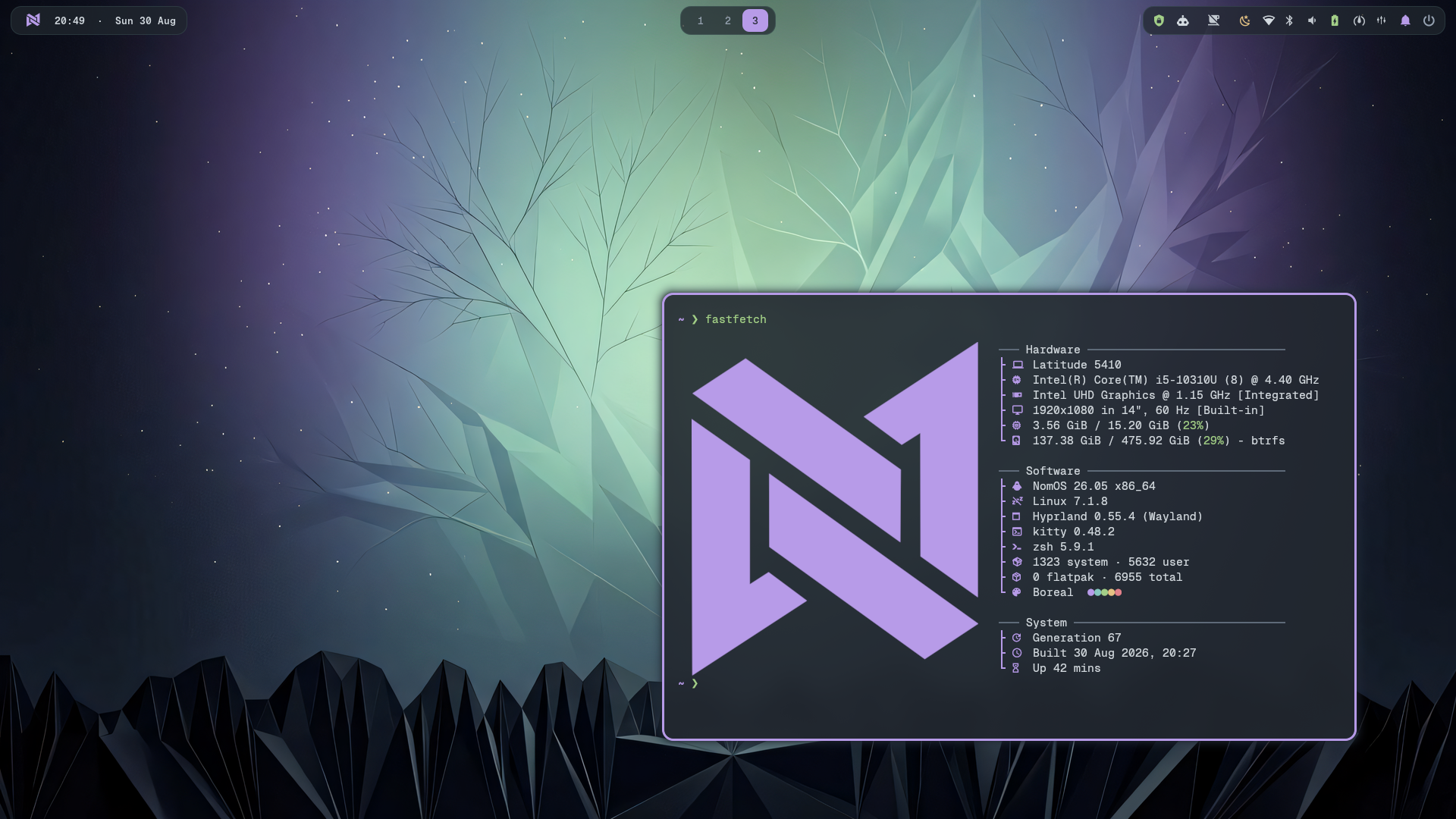
Intelligence without surrendering control.
AI should make a computer easier to use — not turn a probabilistic model into its root of trust. NomOS gives agents a semantic interface to the machine while keeping authority, constraints and verification inside the operating system.
The model interprets. NomOS validates.
Models interpret
Natural language becomes semantic intent. Agents reason about what you mean, not which implementation detail to poke.
NomOS validates
The operating system owns permissions, ranges, readiness and the rules that decide whether an action may happen.
Evidence, not confidence
After an action, NomOS reports what the system can actually establish — not what a model merely believes happened.
How NomOS Works: from intent to verifiable outcomes
Giving an AI model bash access treats error codes and file timestamps as proof. NomOS implements a 6-stage causal lifecycle where mutations are bounded by typed schemas, fixed controllers, and private, invocation-bound receipts.
User Intent
You speak in plain language: "Set night light to 3800 K." Models reason about intent without formulating raw shell scripts or remembering config paths.
NATURAL LANGUAGETyped Operation
The agent selects an advertised Operation (night-light.temperature.set) and binds the contract's content digest and typed JSON input.
Validation & Auth
nom-api-runtime fails closed: enforces schema bounds, validates digest, and resolves acting user via NSS (getpwuid_r), ignoring spoofable env vars.
Fixed Controller
The active NixOS generation runs a pinned controller in a reconstructed allowlisted environment with active locks and private receipt descriptors.
NIX PINNED DRVCausal Result
For persistent-state operations, crash-durable commits emit invocation-bound receipts over a pipe (commit semantics are operation-specific). Mid-operation crashes report unknown.
Observed Evidence
Read-only queries (nom-inspect observe) verify declared state and controller runtime. Independent observation is truth; model belief is not.
Semantic System API vs. Giving an AI Unrestricted Shell Access
Traditional agent systems give LLMs raw bash terminals and hope prompt guidelines prevent catastrophic accidents. NomOS replaces probabilistic restraint with deterministic operating system validation for controlled operations.
Boundary Limitation: The semantic API provides a structured, validated channel for supported operations; it does not sandbox or contain an agent that retains unrestricted shell access or ambient root permissions.
| Dimension | Raw Shell Access (Bash / Terminal) | NomOS Semantic Machine API |
|---|---|---|
| Input Boundaries | Unbounded command strings. Vulnerable to hallucinated syntax, prompt injection, and catastrophic typos (e.g. rm -rf /). |
Closed JSON schemas. Rigorous integer ranges and strict property validation refuse invalid input before execution starts. |
| Execution Authority | Inherits whatever ambient shell environment exists ($PATH, $USER, $HOME, injected wrappers). |
Resolved by getpwuid_r through the system account database (NSS) and active NixOS system generation. Ambient shell variables and spoofed paths are ignored. |
| Proof of Outcome | Process exit status ($? == 0) or stdout sniffing. A silent crash or partial write is mistaken for success. |
Private, invocation-bound receipts over kernel pipe descriptors (not cryptographic attestations). Outcomes are strictly partitioned: established, failed, or unknown. |
| Uncertainty Handling | False certainty. If a command exits mid-operation, the agent assumes failure or loops indefinitely. | Deterministic crash-window semantics. Failures between atomic file rename and directory fsync honestly report unknown. |
| Inspection & Verification | Ad-hoc scraping of logs, grepping config files, or relying on model confidence. | Read-only typed Evidence queries (nom-inspect observe) separate declared intent from running controller telemetry. |
Interactive Simulation: night-light.temperature.set
CLIENT-SIDE SIMULATION
Interactive model grounded in shipping NomOS contract specifications. Demonstrates pre-launch refusal, crash-window uncertainty, and causal receipts vs. observed Evidence.
Case 1: Schema Refusal (Pre-launch Refusal)
Agent attempts to set temperature to 8000 K (above advertised schema maximum of 6500 K). Pre-launch validation rejects the payload before any controller execution.
Built from proven parts.
Designed to work as one.
NomOS brings together mature open-source software with its own interfaces, tooling and defaults — then integrates it into a workstation that feels coherent from the first boot.
You shouldn’t have to think about which component does what. The desktop, system controls, themes and everyday workflows should simply feel like parts of the same system.
Curated components
Proven software, chosen deliberately rather than accumulated.
NomOS-built interfaces
Purpose-built tools fill the gaps where the Linux desktop needs something better.
Integrated by design
Themes, controls and workflows are made to behave consistently across the system.

Power underneath.
NomOS is built so system changes are easier to understand, easier to reproduce and easier to undo.
Update with confidence. Experiment without fear. Go back when something doesn’t work.
Reproducible
The system can describe the state it is meant to be in.
Recoverable
Changes don’t have to be permanent. Working states remain within reach.
Understandable
Configuration has structure instead of becoming a pile of accumulated tweaks.
Your computer should remember when everything worked.
Time Vault lets you create Time Anchors — recovery points that bring the system and your files back together.
NomOS restores system state through declarative generations and tracked configuration, while filesystem snapshots recover your files. Updates and regenerations are protected automatically with recovery points created before and after changes.
Change freely. Go back completely.
Built on real machines. Still deliberately private.
NomOS is in private alpha. The core system, semantic API, Command Deck, recovery model and agent architecture are being developed together on real hardware.
There is no public ISO yet. We are making the project visible before making it generally available — so the system can mature without pretending it is finished.
Questions, ideas, or interested in collaborating? We'd love to hear from you.
contact@nomoslinux.org